
Smart Odour Monitoring
Bringing Real-Time Visibility to Facility Operations
Large-scale airport environments demand continuous situational awareness and rapid coordination during emergencies. The objective was to establish a discreet, reliable, and scalable alert system that could enhance operational preparedness without disrupting day-to-day airport activities.
Why Odour Monitoring Matters
The Nwaresoft Approach
- Deployment at Rajiv Gandhi International Airport
- Instant emergency alert system
- Airport-wide wireless connectivity
- Centralized monitoring and response
- Reliable long-range communication
- Scalable solution for critical infrastructure
The Nwaresoft Approach
Nwaresoft’s solution combines compact IoT-enabled sensors with a centralized monitoring platform. The sensors collect configured environmental and gas-related readings and tra
What Can Be Monitored?
- Odour Level
- H₂S (Hydrogen Sulphide) Status
- NH₃ (Ammonia) Status
- Gas Detection Status
- Location-Wise Sensor Status
- Recorded Date and Time
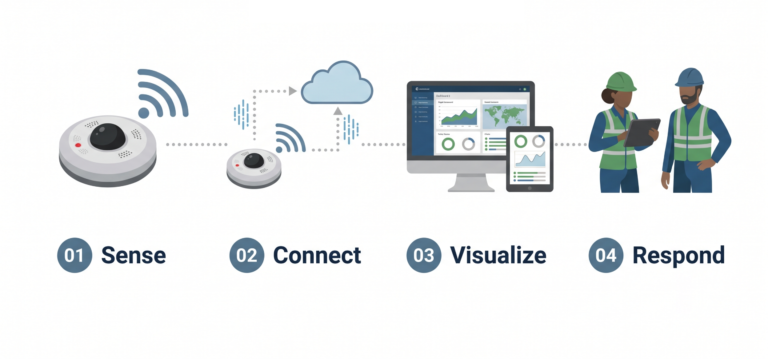
How It Works
01 Sense — Connected sensors monitor configured environmental and gas-related parameters.
02 Connect — Sensor readings are transmitted to the monitoring platform.
03 Visualize — The dashboard presents the latest status and recorded readings by monitoring point.
04 Respond — Teams can review unusual conditions and take appropriate operational action.
From Data to Operational Visibility
The value of connected monitoring goes beyond simply collecting sensor readings. By bringing field data into a centralized dashboard, organizations gain a clearer view of facility conditions, time-stamped records for review, and a foundation for more responsive maintenance and operational workflows.
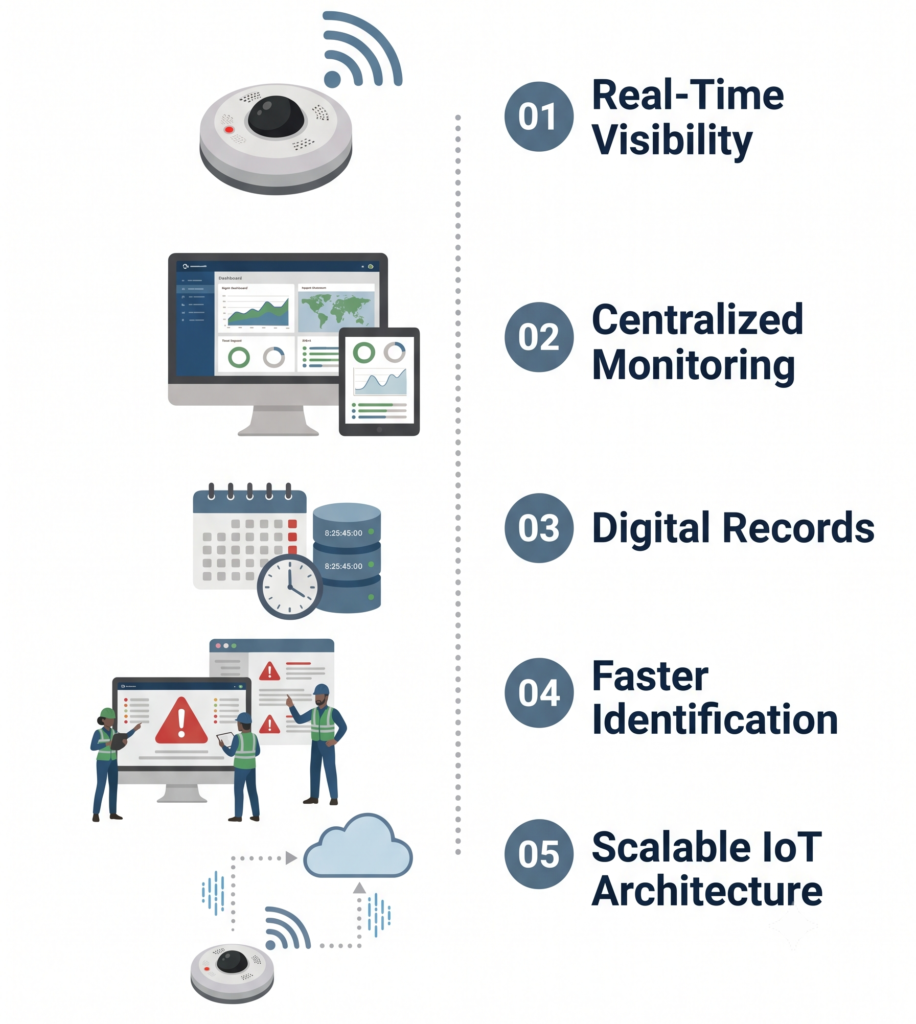
Key Outcomes
Real-Time Visibility Monitor environmental conditions through connected sensors and a centralized interface.
Centralized Monitoring — View multiple monitoring points from a single dashboard.
Digital Records — Maintain time-stamped readings for operational review.
Faster Identification – Help teams recognize unusual conditions more quickly.
Scalable IoT Architecture — Extend monitoring to additional locations and use cases as requirements grow.
Where It Can Be Applied
The solution can support environmental monitoring across petrol pump facilities, commercial facilities, public infrastructure and other operational environments where continuous odour or gas-condition visibility is valuable.